Bright Long Secondary Period Stars for Follow-up Observations
- Detta ämne har 0 svar, 1 deltagare, och uppdaterades senast 25-12-19 09:13 av
Hernán.
-
FörfattareInlägg
-
19 december, 2025 kl. 09:13 #13878
Jag kom på denna intressanta artikel (pre-print) som publicerades i arXiv i förrgår:
Bright Long Secondary Period Stars for Follow-up Observations
Long secondary period (LSP) variable stars are a subclass of long-period variables (LPV) that exhibit additional long-term variability alongside pulsations. Despite being observed in over 30% of LPVs, the reason behind the LSP phenomenon is still debated. The most favoured explanation, supported by recent growing evidence, is binarity, where the pulsating giant star has a substellar-mass companion. To further test this hypothesis, it is important to identify bright LSP variables, for which high-quality spectroscopic and interferometric observations can be obtained more easily. Motivated by the absence of a catalog of bright nearby LSPs, we searched the All Sky Automated Survey (ASAS) data in the -band magnitude range 5.5-14 mag, and for declinations <28°. The resulting catalog contains 23 LSPs, 13 of which are new discoveries. We compare our catalog with the LSP lists available in the literature.
https://arxiv.org/abs/2512.15874
Det handlar om ljusstarka LPV stjärnor med sekundära perioder. Mekanismerna bakom sekundära perioderna verkar vara fortfarande debatterade och oklara. Detta ser ut som något där vi amatörer kan bidra med våra observationer (fotometri, spektrometri).
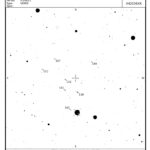
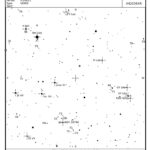
Författarna ger en lista med stjärnor framförallt i södra hemisfären, ibland lång söderut. Här nere har jag valt bort sydliga stärnor från deras tabell 1 (https://www.astrouw.edu.pl/asas/i_LSP/bright_lsp_asas.txt). Det som blir kvar är 6 lätt observara stjärnor norr om ekvator.
Title: Bright Long Secondary Period Stars for Follow-up Observations
Authors: P. Iwanek, D. M. Skowron, G. Pojmański and I. Soszyński
Table: Table bright_lsp_asas.txt with all information about bright variables exhibiting LSP behaviour,
i.e., ASAS, Gaia DR3 and other IDs, equatorial coordinates (R.A. and Decl.), mean ASAS V-band magnitude,
V-band amplitude, long secondary period, pulsation period, Gaia parallax, parallax uncertainty,
distance, distance uncertainty, the Renormalized Unit Weight Error (RUWE),
and JHKs-bands magnitudes from 2MASS.
================================================================================
Byte-by-byte Description of file: bright_lsp_asas.txt
——————————————————————————–
Bytes Format Units Label Explanations
——————————————————————————–
1- 13 A13 — ASASID ASAS Star ID
15- 16 I2 h RAh Hour of Right Ascension (J2000)
18- 19 I2 min RAm Minute of Right Ascension (J2000)
21- 22 I2 s RAs Second of Right Ascension (J2000)
24- 24 A1 — DE- Sign of the Declination (J2000)
25- 26 I3 deg DEd Degree of Declination (J2000)
28- 29 I2 arcmin DEm Arcminute of Declination (J2000)
31- 32 I2 arcsec DEs Arcsecond of Declination (J2000)
34- 40 F7.2 d PL Long Secondary Period
42- 50 F9.5 d PS Pulsation Period
52- 56 F5.3 mag Vmag Mean ASAS V-band magnitude
58- 62 F5.3 mag Vampl ASAS V-band brightness amplitude
64- 82 I19 — GaiaDR3ID Gaia DR3 Star ID
84- 89 F6.4 mas plx Parallax
91- 96 F6.4 mas e_plx Parallax Uncertainty
98-100 I3 pc d Distance
102-103 I2 pc e_d Distance Uncertainty
105-110 F6.4 — RUWE Renormalized Unit Weight Error
112-116 F5.3 mag Jmag 2MASS J-band magnitude
118-123 A6 mag Hmag 2MASS H-band magnitude
125-130 F6.3 mag Ksmag 2MASS Ks-band magnitude
132-140 A9 — OtherID Other Star ID
——————————————————————————–
Note: The table is ordered by increasing right ascension.
——————————————————————————–064943+2529.1 6 49 43 25 29 6 231.75 85.01045 6.960 0.511 3381600414124419584 1.8846 0.0367 521 10 1.1350 4.094 3.344 3.099 QU Gem
130005+0018.5 13 0 5 0 18 30 471.35 47.06715 7.539 0.273 3689410721541718272 1.5102 0.0306 646 14 1.0170 4.083 3.103 2.815 HD 112915
181755+1758.9 18 17 55 17 58 54 630.12 76.68265 7.338 0.701 4523659121810239744 4.2058 0.0744 237 4 1.8110 1.285 0.248 0.070 IQ Her
182653+0354.8 18 26 53 3 54 48 828.36 74.50382 8.031 0.910 4284072754993455616 2.2172 0.1170 436 24 1.0310 2.103 NULL 0.827 V0988 Oph
204528+1805.4 20 45 28 18 5 24 1183.12 78.53356 6.716 0.862 1813013108479261312 2.9865 0.1006 328 12 1.0600 1.026 -0.019 -0.212 U Del
205813+2353.7 20 58 13 23 53 42 415.32 47.33488 7.425 0.463 1839669874543519872 1.3914 0.0221 705 10 0.9970 4.111 3.201 2.888 HD 199696 -
FörfattareInlägg
- Du måste vara inloggad för att svara på detta ämne.

Senaste diskussionerna
-
Geminid nedslag på Månen
tråd av
PeterR
-
Saturnus
tråd av
Petter Öhman
-
NSV01161
svar av
Thomas Karlsson
-
Månadens bild
svar av
Petter Åström
-
Dammiga Handens galax
svar av
Fredrik Silow
-
Aktuell solaktivitet
svar av
Thomas Karlsson
-
Embryonebulosan
svar av
Gabriel Wiklund
-
Komet Lemmon & NGC 4618
svar av
LasseH
-
Komet Lemmon & NGC 4618
tråd av
AlexFerein
Månadens bild i galleriet
Årets bild i galleriet
Senaste bilderna i forumet
Senaste nytt från SAAF-webben
- Värmland Star Party 2026
- Apertur blir SAAF:s nya medlemstidskrift!
- Telescopium nummer 4 2025 snart ute – 93:e och sista numret!
- Observationsbeställningar – nytt sätt att ta bilder med fjärrteleskopet
- Telescopium nr 3 2025 ute snart!
- Årsmöte 2025

- Telescopium nr 2 2025 ute snart!
- Telescopium nr 1 2025 ute snart!
- Telescopium nr 4 2024 ute snart!
- Telescopium nr 3 2024 ute snart!
Kalendariet
Antal unika dagsbesökare (unika IP)
Idag: 170 st
Senaste 7 dagarna: 2931 st
Senaste 30 dagarna: 12148 st


-300x300.jpg)